Posts

Prayer in Brief: "... now that my every act is love." (CB, 28)
Image
One of the key points the Catechism of the Catholic Church makes about prayer is that it involves a mutual relationship between God and the person praying. "Prayer is the encounter of God's thirst with ours. God thirsts that we may thirst for him," the Catechism states (no. 2560). Moreover, God is the initiator of the relationship: "In prayer, the faithful God's initiative of love always comes first (no. 2567). The human act of praying is a response to God's initiative. Perhaps this is not our experience. The move from saying prayers to meditating or praying from the heart can be difficult. Even the most loquacious person can be at a loss for words. I may not have a lot to say to God. Even more so does it seem that God has little to say to me. I wait in silence for God to speak and I hear nothing. God doesn't seem to be holding up his end of the deal. However, as I progress further in prayer, I realize God does speak. Usually not in words and often not at...

"I am with you until the end of time" (Mt 28, 20)

Image
We live in a time of computers, of the virtual, of the immediate. News travels from one side of the world to the other in a fraction of a second. We have immediate access to a mountain of information. All of this undoubtedly has a positive value, as the Church has pointed out on numerous occasions. However, we do also run the risk of falling into the worrying superficiality of data with no criteria for analysis; information without formation, a light, post-modern culture which exalts the empty, the passing, the insignificant. Perhaps what this society needs, more than ever, is something that the Carmelite charism can offer: the meaning of contemplation, of spiritual depth. The Carmelite should be a man or woman with inner life, with depth, with spiritual riches, a man or woman who in the midst of the hustle and bustle of daily life, of the problems and contradictions of our time is able to create the inner silence in which God may speak. Sometimes we too are swept up in prejudice, hurr...

A Little Mediterranean Magic!

Image
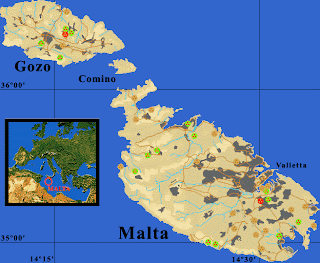
Megaliths, medieval dungeons and Calypso's Cave - Malta is positively mythic. The narrow meandering streets of its towns and villages are crowded with Renaissance cathedrals and Baroque palaces. As the countryside is dotted with the oldest known human structures in the world, Malta has rightly been described as an open-air museum. With 7,000 years of history, the Maltese Islands are steeped in culture and heritage. The Islands went through a golden Neolithic period, the remains of which are the mysterious megalithic temples dedicated to the goddess of fertility. Later on, the Phoenicians, the Carthaginians, the Romans and the Byzantines, all left their traces on the Islands. There are megalithic monuments, Bronze Age dolmens, Punic tombs, remains of Roman Villas and traces of prehistoric man, which defy explanation, such as the mysterious 'cart' tracks. For three millennia, from around 5200 BC, the archipelago was home to a unique, temple-building civilisation. Ma...

Teatro Cristiano: El Hombre

Image
Monólogo de un hombre: (eufórico)- ¡Hola! ¡Muy buenas noches público presente! Permítanme presentarme: Yo soy el hombre, el protagonista de la historia. ¿Qué? ¿No me reconocen? Franz Kafka en su libro La Metamorfosis escribió sobre mí: “¡Yo soy una cadena que no se puede romper, una muralla que no se puede derribar.” Ése soy yo! ¡Luchando! ¡Peleando! ¡Cayendo! Pero volviéndose a levantar en pos de la gloria y la conquista!Así lo hizo Alejandro Magno con su hueste de valientes cuando desde Macedonia hasta las orillas del río Indo levantaron un imperio. O cuando Julio César cruzando el Rubicón lanzó la famosa frase que perdura a través de los tiempos: “Vini, vidi, vicci” que traducido es: Vine, ví y vencí. ¡Ah! El hombre no sólo se conforma con conquistar imperios sino que se lanza a la aventura de la conquista del espacio. Desde Julio Verne, el afamado escritor francés de ciencia-ficción, hasta las sondas que se envían al planeta Marte; sin olvidar del momento cumbre cuando Neil Amstro...

O night that has united the Lover with his beloved, transforming the beloved in her Lover (San Juan de la Cruz)

Image
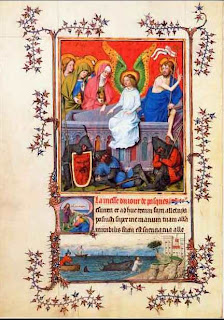
Respóndens autem Angelus, dixit muliéribus: Nolíte timére: scio enim quod Jesum quæritis, allelúja. And the Angel answered and said unto the women, Fear not ye, for I know that ye seek Jesus, alleluia.

"The righteous shall flourish like the palm tree; he will grow like a cedar in Lebanon." (Psalms 92,12)

Image
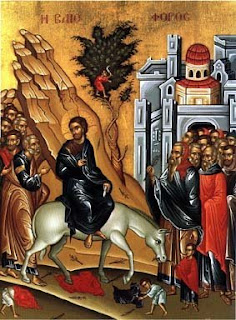
When Thou, O Lover of Mankind, our God, wast come to Bethsphage, to the Mount of Olives, which is close by Bethany, riding upon an ass's colt, the Hebrew children from Jerusalem met Thee carrying palm fronds in their hands, crying out and saying: Hosanna in the Highest ; and the faithful people, with branches of trees, cried: Hosanna to the Son of David, blessed is He that cometh and shall come again in the Name of the Lord, the King of Israel. Wherefore we the faithful also, with fear and love, with the signs of victory, cry out in joy to Thee, Who alone art immortal and the Victor, Who hast dominion over life and death: Blessed is He that cometh in the Name of the Lord, He that is blest and maketh us all to live, who have been found worthy to partake of Thy holy, most pure, immortal, life-giving, heavenly and fearful Mysteries unto the remission of our sins. For to Thee belongeth all glory, honor and worship: to the Father, and to the Son, and to the Holy Spirit, now and ever, a...

"Bless the Lord, oh my soul .... who redeems your life from the pit, who crowns you with loving kindness and compassion" (Psalm 103, 2-4)

Image
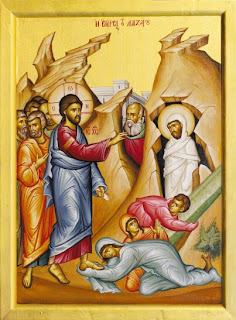
5th Week in Lent – Redeeming love The invitation to participate in the sufferings of Christ becomes ever more pressing. It is necessary that we show our love in carrying the cross together with Jesus. Our eyes are to be transfixed on God Who has annihilated Himself to the extent of death to redeem us: divine mercy is inexpressible. The liturgy reaches its peak in celebrating the mystery of redemption. "It was necessary that Lazarus should die, so that the faith of the disciples might also rise with him from the dead." Peter Chrysologus (c.400-450) Read the homily of the Holy Church Father Peter Chrysologus on today´s Gospel reading: http://peopleofstmarymagdalene.blogspot.com/2008/03/on-sunday-raising-of-lazarus.html De Los Sermones de San Agustín, Obispo (98, 4-7) Os he dicho esto con el fin de convenceros de que nuestro Señor Jesucristo realizó los milagros para significar algo con ellos, de forma que, exceptuando su ser algo admirable, grande y divino, aprendiésemos otra c...